
Tokenization Of Real-World Assets Under Turkish Law

The Asset-Holding SPV Model, Regulatory Perimeter and Practical Feasibility
ADMD & Black Sea
Real-world asset (RWA) tokenization uses distributed-ledger technology to represent and administer rights relating to conventional assets. In the structure considered in this article, a special-purpose vehicle (SPV) retains legal ownership of real estate or another underlying asset, while digital tokens represent shares in the SPV or contractual economic rights connected with it. The structure is intended to facilitate fractional participation, controlled transfers, investor reporting and compliance through a digital infrastructure without attempting to replace ordinary company, property or contract law.
Turkish law does not contain a single, self-contained regime for RWA tokenization. The legal outcome is determined by the rights granted to the token holder and by the activities carried out around the token. A token may constitute a digital record of an existing right, an actual or purported company interest, a contractual claim, a debt-like instrument, a fund interest or a capital-markets instrument. Each route produces materially different consequences under the Capital Markets Law, the Turkish Commercial Code, property law, investment-fund legislation, the rules governing crypto-asset service providers, anti-money laundering legislation and tax law.
Law No. 7518 Amending Capital Markets Law No. 6362 (published in the Official Gazette No. 32590 dated 2 July 2024), which entered into force on 2 July 2024, established the statutory framework for crypto assets and crypto-asset service providers and expressly empowered the Capital Markets Board of Türkiye (“SPK”) to regulate the issuance of capital-markets instruments as crypto assets, crypto assets granting rights specific to capital-markets instruments, and the first sale or distribution of certain other crypto assets. The 2025 secondary legislation regulates the establishment and operation of service providers, platform activities, listing, transfers, custody, customer-asset protection and capital adequacy. These provisions create a route for regulated digital-asset activity, but they do not amount to a general permission to issue an asset-backed token outside the existing product and licensing rules.
The asset-holding SPV model is therefore not categorically prohibited in Türkiye, but its feasibility is conditional. Direct ownership of Turkish immovable property cannot presently be transferred merely by moving a token on a blockchain. A token intended to represent an SPV share must be reconciled with the applicable share-transfer and corporate-record requirements, unless it is issued through a specific SPK-authorised route under which the electronic records are legally recognised.
A token providing only contractual economic rights may avoid some company-law formalities, but it may still be treated as a regulated investment arrangement according to its substance. Offering method, target investors, custody, payment flows and any secondary market must therefore be designed after the legal classification has been settled.
1. The Proposed Asset-Holding SPV Structure
The proposed structure does not seek to place title to the underlying asset directly on a blockchain. Instead, an SPV acquires and holds the asset in the conventional manner. The token operates one level above the asset and represents an interest connected with the SPV. The model may be illustrated as follows:
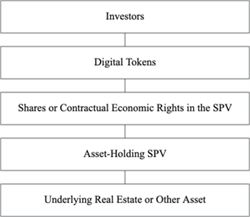
The SPV remains responsible for holding and managing the asset, entering into leases and financing arrangements, maintaining accounting records, receiving income and making legally authorised distributions. Investor onboarding is intended to include identity and beneficial-ownership verification, source-of-funds and source-of-wealth review, sanctions and politically exposed person screening, and, where crypto assets are used, wallet-provenance analysis. Smart-contract functionality may be used to enforce whitelisting, transfer restrictions, lock-up periods and other controls, provided that the code accurately implements the legal documents.
Two expressions in the structure require particular care: ‘shares’ and ‘economic rights’. An SPV share grants a corporate membership position governed by company law. A contractual economic right may entitle the holder to income, redemption proceeds or a share of asset appreciation without making that holder a shareholder. These are not alternative labels for the same legal result. The structure must select one legal model and ensure that the SPV documents, subscription agreement, token terms and smart contract all reflect that model.
The fact that the token is not intended to be openly traded at launch is relevant but not conclusive. A closed distribution and controlled transfers may reduce operational and investor-protection risks. They do not, by themselves, remove the token from capital-markets legislation or the rules governing its first sale, transfer or custody. A later exchange listing or public secondary market would constitute a separate and materially more regulated phase of the project.
2. The Turkish Legal Framework
Türkiye’s dedicated statutory framework for crypto assets was introduced by Law No. 7518 Amending Capital Markets Law No. 6362. The amendments added the principal definitions relating to crypto assets, platforms, custody and crypto-asset service providers, established the SPK’s authorisation and supervisory powers, and introduced provisions concerning the issuance of capital-markets instruments as crypto assets. The framework was subsequently supplemented by the SPK’s secondary legislation issued in 2025.
2.1 Statutory definition of crypto assets and service providers
Capital Markets Law No. 6362 defines a crypto asset broadly as an intangible asset that may represent value or rights, is electronically created and stored using distributed-ledger technology or similar technology and is distributed over digital networks (Art. 3/1-bb). The definition is sufficiently broad to cover a token that represents legal or economic rights relating to an SPV. It does not, however, determine whether the underlying right is a share, debt claim, contractual right or another regulated product.
The Law separately defines a platform as an organisation through which one or more activities such as crypto-asset trading, first sale or distribution, clearing, transfer and the related custody are carried out. Crypto-asset service providers include platforms, authorised custody providers and other organisations designated to provide crypto-related services, including services connected with first sale or distribution (Art. 3/1-cc to dd). Establishment and commencement of regulated service-provider activities require SPK authorisation, and authorised entities may carry out only the activities determined by the SPK (Art. 35/B(1)).
2.2 The 2025 secondary framework
On 13 March 2025, the SPK’s two principal communiqués were published in Official Gazette No. 32840 and entered into force, subject to the transitional compliance periods applicable to existing service providers: Communiqué III-35/B.1 on the Establishment and Operating Principles of Crypto-Asset Service Providers, and Communiqué III-35/B.2 on the Working Procedures, Operating Principles and Capital Adequacy of Crypto-Asset Service Providers. The first governs matters including authorisation, shareholders and management, internal control, risk management, information systems, records and independent audit. The second governs the services that may be offered, trading environments, listing procedures, transfers, custody and capital adequacy.
This framework is principally an infrastructure regime. It determines who may operate a platform, provide custody or carry out other regulated crypto-asset services and under what conditions. The underlying investment product must still be classified separately. The same project may therefore be subject both to product regulation, for example, the rules governing shares, debt instruments or fund interests, and to infrastructure regulation governing the platform, transfer and custody arrangements.
2.3 Capital-markets instruments issued as crypto assets
The 2024 amendments introduced an especially important provision into Article 13 of the Capital Markets Law. The SPK may determine principles under which capital-markets instruments are issued as crypto assets and monitored in the electronic environment maintained by the relevant crypto-asset service providers instead of being monitored through the ordinary Central Registry Agency (MKK) system. Where such an issuance route is used, the electronic records may form the basis for monitoring, asserting and transferring the relevant rights, and the SPK may require integration with MKK.
This provision confirms that Turkish law can, in principle, recognise a tokenized capital-markets instrument. It should not be read as self-executing permission for a private issuer to convert ordinary company shares into tokens at its own discretion. The route depends on the principles determined by the SPK, the regulatory classification of the instrument and the required application or approval process.
2.4 Other crypto assets and the SPK’s product jurisdiction
Article 35/B(6) gives the SPK authority to issue regulations and decisions and to apply measures and sanctions in relation to crypto assets that grant rights specific to capital-markets instruments. It also permits the SPK to establish principles for the sale or distribution on platforms of certain technology-native crypto assets whose value cannot be separated from the underlying distributed-ledger technology, without applying all provisions governing capital-markets instruments.
An RWA token linked to an SPV should not automatically be placed in the second category. Its value ordinarily derives from an identifiable legal relationship and underlying asset rather than solely from the technology. If the token grants rights resembling equity, debt, profit participation, redemption or a collective investment interest, the SPK may analyse the transaction through the legal regime applicable to those rights. Labelling the token as an ‘asset token’ or ‘utility token’ does not determine the outcome.
3. Legal Characterisation of the Token
The decisive question under Turkish law is not which blockchain is used, but what the token holder is legally entitled to demand. The principal alternatives are considered below.
3.1 A token representing actual SPV shares
Under an equity model, token holders are intended to become shareholders of the asset-holding SPV and to acquire rights such as voting, dividends, liquidation proceeds and participation in corporate decisions. The token may serve as the digital representation and transfer mechanism for that membership position.
If the SPV is an ordinary Turkish company and no specific SPK-authorised tokenized issuance route applies, the token cannot safely be assumed to replace the Turkish Commercial Code requirements governing share transfers and corporate records. The applicable rules depend on the company’s legal form and the type of share. Transfers of registered or bearer shares in a joint-stock company are subject to the relevant statutory rules, the articles of association and, where applicable, registration or notification mechanisms. A transfer of a limited-liability company interest generally requires a written transfer agreement with notarised signatures and, unless the articles provide otherwise, general-assembly approval (Turkish Commercial Code, Art. 595).
Accordingly, an on-chain transfer may produce a technological change of wallet ownership without producing the intended corporate-law transfer. The project would need a synchronisation mechanism under which transfers are permitted only when the legally required steps are completed, or a regulated issuance framework under Article 13 in which the electronic record is legally recognised for the relevant instrument.
3.2 A token representing contractual economic rights
A second model leaves the SPV’s shareholding structure unchanged and gives token holders contractual claims against the issuer or SPV. Those claims might include a defined share of rental income, proceeds on disposal of the asset, a redemption amount or another formula-based payment. The holder would not necessarily have voting rights or other corporate membership rights.
This route may reduce the company-law difficulties associated with transferring shares, but it does not remove capital-markets risk. Where investors contribute funds, rely on the sponsor or manager to acquire and manage the asset, and expect a financial return, the economic arrangement may resemble debt, profit participation, a collective investment structure or another regulated capital-markets product. The SPK is likely to examine the substance of the rights, the fundraising method, investor expectations, marketing and transferability rather than the contractual label alone.
3.3 A token as a record or administrative tool only
The lowest product-classification risk arises where the token merely records or facilitates a legal position created and transferred elsewhere and does not independently grant investment rights. Even then, the token ledger must be reconciled with the legally operative register. This limited model may provide administrative efficiency but offers less of the transfer and liquidity functionality ordinarily associated with tokenization.
3.4 Fund and collective investment alternatives
Where multiple investors contribute capital to a professionally managed pool whose purpose is investment in real estate or other assets, an existing regulated fund structure may provide a more legally certain route than a bespoke contractual token. Turkish law already regulates real-estate investment funds and venture-capital investment funds. Real-estate investment fund units are offered to qualified investors and are subject to portfolio, valuation, custody, disclosure and management rules. Tokenized administration of a regulated fund interest may ultimately be possible, but it would need to be integrated into the fund and issuance framework rather than used to bypass it.
4. Corporate and Property Law
4.1 The SPV as owner of the underlying asset
For Turkish real estate, the asset-holding SPV model avoids the need to treat each token holder as a direct co-owner of the underlying property. Ownership of an immovable is acquired through registration with the land registry, subject to the legally required transaction and form (Turkish Civil Code, Arts. 705 and 706). Accordingly, the underlying property may remain registered in the name of the SPV, and a transfer of the token would not, by itself, constitute a transfer of title to the property.
This approach resolves only the property-law layer of the structure. It does not determine whether a token transfer validly transfers shares in the SPV or contractual rights against it. Those matters remain subject to the applicable corporate, contractual and capital-markets rules. Token holders would therefore participate through rights relating to the SPV rather than through direct co-ownership of the property created solely by the token.
4.2 Governance and investor protection
The SPV’s constitutional and contractual documents must address matters that a smart contract cannot resolve on its own. These include appointment and removal of management, reserved matters, conflicts of interest, related-party transactions, valuation, borrowing, sale of the asset, distribution policy, investor reporting, default, deadlock, termination and insolvency.
Where token holders have shareholder rights, corporate voting and distribution procedures must comply with the Turkish Commercial Code and the articles of association. Where they have only contractual rights, the documents must clarify that they are not shareholders and must define the creditor hierarchy and enforcement position. In either case, the legal documents should prevail over code in the event of an inconsistency, while also establishing procedures for correcting or upgrading the smart contract.
4.3 Insolvency and segregation
The project documentation should distinguish the underlying asset, the issuer’s assets, investor funds and any customer crypto assets held by regulated service providers. The Capital Markets Law requires customer cash and crypto assets held by service providers to be segregated from the service provider’s assets and provides protection against attachment for the service provider’s debts (Art. 35/C(7)). This statutory segregation does not automatically insulate token holders from insolvency risk at the SPV or issuer level. Bankruptcy remoteness, security, distribution waterfalls and enforcement rights must therefore be addressed in the corporate and financing structure.
5. Offering, Distribution, Platform and Custody
5.1 First sale or distribution
The Capital Markets Law empowers SPK to regulate the first sale or distribution of crypto assets through platforms (Art. 35/B (4)). A project involving the systematic issuance of tokens to investors cannot be analysed solely as a bilateral contract exercise. The issuer, offering documents, investor category, marketing channels, subscription flow and the role of any platform must be mapped before launch.
A restricted placement to a small number of professional or qualified investors may reduce consumer-protection, distribution and market-conduct concerns. It does not automatically disapply the Capital Markets Law where the token itself is a capital-markets instrument or where a regulated service is being performed. If the product is structured as an ordinary capital-markets instrument sold without a public offering, the applicable issuance document and private-placement rules would still need to be considered.
5.2 Listing and secondary trading
Platforms are required to maintain written procedures for determining which crypto assets will be listed, first sold or distributed and when trading will be terminated (Art. 35/C(2)). The 2025 secondary legislation provides the operational framework for listing and trading. Listing does not constitute a public guarantee or an endorsement of the asset.
The contemplated absence of an open secondary market at launch is therefore a sensible risk-control measure. Transfers may be restricted to verified and whitelisted investors and conditioned on completion of legal transfer steps. Any subsequent public listing, liquidity programme or market-making arrangement should be treated as a separate phase requiring a fresh regulatory, market-integrity and disclosure analysis.
5.3 Custody and transfers
The Capital Markets Law provides that platform customers’ crypto assets should principally be held in their own wallets. Where customers do not choose self-custody, custody must be provided by banks authorised under the SPK framework and deemed appropriate by the Banking Regulation and Supervision Board, or by other institutions authorised by the SPK. Customer cash must be held with banks (Art. 35/C (6)). Transfer and wallet records must be secure, accessible and traceable, and service providers must comply with SPK and MASAK transfer requirements (Art. 35/C (5)).
The identity of the custodian and the legal location of the token are therefore central structural questions, not post-launch operational details. The issuer should not hold investor keys or perform custody functions unless it is legally permitted and operationally equipped to do so. Self-custody may remain available, but transfer restrictions, lost-key procedures, inheritance, court orders and sanctions controls must be addressed.
6. AML/CFT and Financial-Crime Compliance
Crypto-asset service providers are obliged entities under the Turkish anti-money laundering framework. The Capital Markets Law expressly requires them to identify customers in accordance with Law No. 5549 and related legislation (Art. 35/C(1)). MASAK’s updated sector guidance (MASAK, Crypto Asset Service Provider Guide, updated and published on 30 September 2025) addresses customer identification, remote onboarding, enhanced measures, the Travel Rule, transfer restrictions, politically exposed persons, suspicious transaction reporting, information provision and compliance-programme obligations.
An institutional RWA project should therefore include, at minimum, identification and verification of individuals and legal entities, beneficial-owner checks, sanctions and PEP screening, risk classification, source-of-funds and source-of-wealth review, suspicious transaction procedures, record retention and ongoing monitoring. Where crypto assets are accepted, the project should also use blockchain analytics to assess wallet exposure to sanctions, fraud, stolen assets, ransomware, mixers and other high-risk activity.
The role of a compliance-build partner must be distinguished from the role of the legally responsible, obliged entity. A specialist provider may design policies, conduct or support due diligence, deploy screening tools and document controls. Statutory responsibility for onboarding, monitoring, reporting and regulatory compliance remains with the entity on which the law imposes those obligations. Outsourcing arrangements should therefore define governance, access to records, audit rights, escalation, confidentiality and ultimate decision-making responsibility.
7. Crypto Subscriptions and the Payment Restriction
The 2021 Regulation on the Disuse of Crypto Assets in Payments (published in Official Gazette No. 31456 dated 16 April 2021 and entered into force on 30 April 2021) prohibits the direct or indirect use of crypto assets in payments and the provision of services designed for such use. It also prohibits payment service providers from developing business models that directly or indirectly use crypto assets in the provision of payment services or the issuance of electronic money and prohibits payment and electronic-money institutions from intermediating fund transfers to or from platforms providing crypto-asset trading, custody, transfer or issuance services.
Whether the delivery of BTC, ETH or a stablecoin in return for an investment token constitutes a prohibited payment, a crypto-asset exchange, an in-kind contribution or another investment transaction requires analysis of the exact flow. The payment restriction should not be treated as a general prohibition on holding or trading crypto assets, but neither should a crypto subscription be assumed permissible without structuring.
A fiat-based subscription structure may present a more straightforward route from a Turkish regulatory and operational perspective. Where crypto-funded subscriptions are contemplated, the payment flow, conversion, custody, valuation, source-of-funds evidence, accounting treatment and timing of token allocation would require separate analysis under the applicable payment, crypto-asset and AML rules.
8. Cross-Border and Offshore Structuring
An offshore issuer or holding company may provide access to international investors, custodians, banks and regulated digital-asset regimes. It does not remove Turkish law from a project involving Turkish assets. Turkish property, corporate, tax, foreign-investment and enforcement rules continue to apply to the Turkish asset-owning entity and its activities.
Turkish regulation may also apply where an offshore platform or service provider targets persons resident in Türkiye. Article 99/A of the Capital Markets Law treats activities directed by foreign platforms at Turkish residents as unauthorised service-provider activity. Opening a workplace in Türkiye, creating a Turkish-language website, or conducting direct or indirect promotion and marketing through persons or organisations resident in Türkiye are statutory indicators that the activity is directed at Turkish residents.
The jurisdictional analysis should therefore identify the issuer, SPV, platform, custodian, banks, investors, marketing channels, governing law and dispute forum. ‘Offshore’ should be used to allocate functions to a suitable regulated jurisdiction, not as a substitute for Turkish compliance.
9. Tax Considerations
Tokenization does not detach the structure from the ordinary tax consequences of the underlying legal relationships. At SPV level, rental income, operating profit and gains on disposal of Turkish assets remain subject to the applicable corporate and transaction taxes. At investor level, the result may differ depending on whether the return is a dividend, interest, contractual revenue participation, redemption payment, liquidation distribution or gain on disposal of a share or token.
The structure may also raise withholding, VAT, stamp-tax, transfer-pricing, permanent-establishment and treaty issues. The tax treatment of the token cannot be determined before its legal character, and the cash-flow waterfall are fixed. Given that the tax treatment depends on the legal character of the token and the relevant payment flows, the final tax analysis should be confirmed on a transaction-specific basis before issuance.
10. Feasibility under Turkish Law
The Turkish-law position may be summarised by distinguishing the principal forms of the proposed model. Direct tokenization of title to Turkish real estate is not presently a workable substitute for a land-registry transfer. The token may refer to the property and track economic participation, but moving the token does not itself convey registered ownership of the immovable.
Tokenization of actual shares in an asset-holding SPV may be workable in principle, but only if the issuance and transfer method is legally integrated with the applicable corporate and capital-markets framework. An ordinary token ledger cannot simply be declared to replace statutory share-transfer rules. One possible route may involve a structure recognised by the SPK under Article 13, while alternative structures would require separate analysis under the applicable corporate and capital-markets rules. In all cases, the on-chain records should be aligned with the legally operative corporate or regulatory records.
A token granting contractual economic rights may also be workable in principle. It avoids the assertion that each token transfer is a corporate share transfer, but it must be reviewed for possible treatment as debt, profit participation, a collective investment interest or another capital-markets product. Careful drafting does not remove regulation where the economic substance is investment fundraising.
A closed initial distribution, qualified or institutional investor base, whitelisted transfers and the absence of open secondary trading improve the risk profile and may form part of a viable first-stage structure. They are design features, not blanket exemptions. First sale or distribution, platform activity, custody and marketing remain subject to their own legal analysis.
The legal analysis above establishes the regulatory perimeter. Whether a proposed structure can operate effectively within that perimeter will also depend on the compliance and operational controls embedded in the token, the issuer and the surrounding service-provider framework.
These controls should address risk-based onboarding and screening, transfer restrictions, custody and key governance, transaction monitoring, record-keeping, and the allocation of responsibilities between the obliged entity and any compliance-build partner. Appendix A sets out these controls at framework level. Their precise calibration will depend on the token’s legal characterisation, the target investor base and the proposed offering model.
11. Conclusion
The asset-holding SPV model may provide a workable analytical starting point for RWA tokenization involving Turkish assets, as it preserves conventional legal ownership of the underlying asset while allowing digital infrastructure to support investor administration, controlled transfers, reporting and compliance. Turkish law also provides a statutory basis under which the SPK may determine the principles applicable to the issuance of capital-markets instruments as crypto assets.
The model is not, however, a standard product that can be implemented merely by adding a smart contract to an existing company. Its feasibility depends first on identifying the intended purpose of the token and the precise rights it grants. Those features will determine whether the token should be analysed as an SPV share, a contractual economic right, a debt or profit-participation instrument, a fund interest, a capital-markets instrument or another category of crypto asset. The resulting classification will in turn determine the relevant corporate documentation, SPK process, offering and service-provider structure, custody and transfer arrangements, AML/CFT controls and tax treatment.
Turkish law does not impose a single general prohibition covering every form of RWA tokenization. Any proposed structure must nevertheless be assessed by reference to the rights attached to the token, the offering and transfer model, the target investors and the regulated entities involved. A restricted structure aimed at institutional or qualified investors may present a more manageable starting point, but it is not exempt from applicable issuance, authorisation, custody, AML/CFT or marketing requirements. Any public trading or broader retail distribution should be treated as a later and separately regulated phase.
The analysis in this article provides a general legal framework and may be developed further once the contemplated token’s commercial purpose, the precise rights attached to it, the identity and jurisdiction of the issuer and SPV, the target investors, the subscription and transfer mechanics, the custody model and any proposed secondary market are defined. Those features will ultimately determine the appropriate legal and regulatory structure under Turkish law.
October 14, 2026
About the authors
ADMD / Mavioglu & Alkan is a Turkish full-service law firm founded in 2004 and based in Istanbul. It provides legal consultancy and litigation services to businesses, financial institutions and investors, advising on sophisticated corporate and financial transactions, tax and real-estate matters, and complex dispute-resolution proceedings. The firm combines the close attention of a private practice with the professional standards of an international advisory firm.
Black Sea is an independent AML, CFT and sanctions advisory. It designs and builds compliance frameworks and supports their operation for regulated and digital-asset businesses across frontier and Gulf markets. It is not a law firm.
Appendix - Operational Compliance Controls
This appendix sets out a framework for operational compliance controls that can be adapted to the relevant jurisdiction. The applicable thresholds, risk weightings and jurisdictional scope should be calibrated once the token’s legal characterisation, investor base and offering model have been determined.
Risk-based customer due diligence. Individuals and legal entities should be identified and verified, beneficial owners identified in accordance with the applicable threshold, and customers classified by risk according to customer type, product, geography and channel. The framework should provide for standard, simplified and enhanced due diligence, where permitted, with enhanced measures triggered by high-risk jurisdictions, politically exposed person status, complex ownership structures or unusual sources of funds. Customer information should be reviewed periodically according to the applicable risk tier.
Sanctions and PEP screening. Investors, beneficial owners and counterparties should be screened at onboarding and on any change, with ongoing rescreening against updated lists, senior sign-off for politically exposed persons, and documented match-handling and false-positive procedures.
Source of funds and provenance. Evidence should be obtained in proportion to risk and ticket size. Where subscriptions are made in crypto assets, wallet provenance should be analysed with blockchain analytics, scoring exposure to sanctioned addresses, mixers, stolen funds, fraud and other high-risk services against a documented policy for acceptance, review and rejection.
Transfer controls in code. Whitelisting should ensure that only screened addresses can hold the token, with lock-ups and transfer restrictions enforced by the smart contract, rescreening on transfer, and alignment of the on-chain register with the legally operative register.
Travel Rule and monitoring. The framework should provide Travel Rule information handling for intermediated transfers where required by applicable law, ongoing monitoring for unusual patterns, and an escalation and suspicious-transaction reporting workflow that runs to the responsible entity, with case management and record-keeping.
Custody and key governance. The project should make a documented choice between self-custody and authorised custody and should set key-management standards, procedures for lost keys, inheritance, court orders and sanctions freeze, and segregation of customer assets where an authorised custodian is used.
Programme, records and outsourcing. The obliged entity should maintain a written AML and CFT programme, a risk assessment, policies, training and independent review or internal audit, as the applicable rules require, with record retention to the applicable period. Where controls are delivered by a build partner, the arrangement should provide documented service levels, audit rights, access to records, escalation, four-eyes approval on high-risk decisions and clear ultimate decision-making, with statutory responsibility remaining with the obliged entity.
These controls are designed to be built in from the first allocation rather than retrofitted before an examination. Nothing in this analysis should be read as indicating that any proposed issuance, distribution, custody or secondary-market arrangement may proceed without the approvals, authorisations or other regulatory processes required in the circumstances.
DISCLAIMER: THIS ARTICLE IS PROVIDED FOR GENERAL INFORMATIONAL PURPOSES ONLY AND DOES NOT CONSTITUTE LEGAL, TAX, INVESTMENT, REGULATORY OR COMPLIANCE ADVICE